Custom AI systems for operations teams
The work your team shouldn’t be doing.
AI agents that run inside the systems you already use, doing the extracting and matching your team currently retypes by hand.
Measured on real engagements
What actually changed
AI IVR Automation for Mortgage Verification
A leading mortgage servicer was spending 20–30 minutes per verification call. We cut that to under 5 minutes — with no human involvement.
Faster per verification
80%
Average verification time
20–30 minutesbecameUnder 5 minutes
Human involvement
100% manualbecameLess than 10%
Data capture error rate
3–5%becameBelow 1%
Cost per verification
Baselinebecame60% reduction
Processing capacity
Limited by team sizebecame3× without new hires
Running in production for













What we build
Three practices, and the work inside them.
Automation
For work that already happens the same way every time.
- Custom CRM and ERP synchronisation
- Automated data extraction and entry
- Email and chat operations automation
- Voice and IVR call automation
- Web data extraction and monitoring
- Lead routing and document generation
- Reduced operational turnaround times
Tailored AI Solutions
For work that needs to understand your material, not generic text.
- Intelligent document processors
- Bespoke customer support agents
- Conversational agents for outreach and qualification
- Semantic search across proprietary databases
- Scheduling and matching engines
- Secure, sovereign data hosting
AI Consultancy
For when the question is what to automate first.
- Process bottleneck analysis
- Software cost and usage audits
- Detailed automation roadmaps
- Product and market strategy for AI features
- Enterprise AI adoption frameworks
- Technical feasibility studies
If the process you have in mind is not on this list, it is still worth describing. Most of what we build started as something a team assumed could not be automated.
How each one worksWhere we deliver
The same problem wears different clothes.
Automation
Automating manual database syncs, lead routing, document processing, and administrative bottlenecks.
See automation work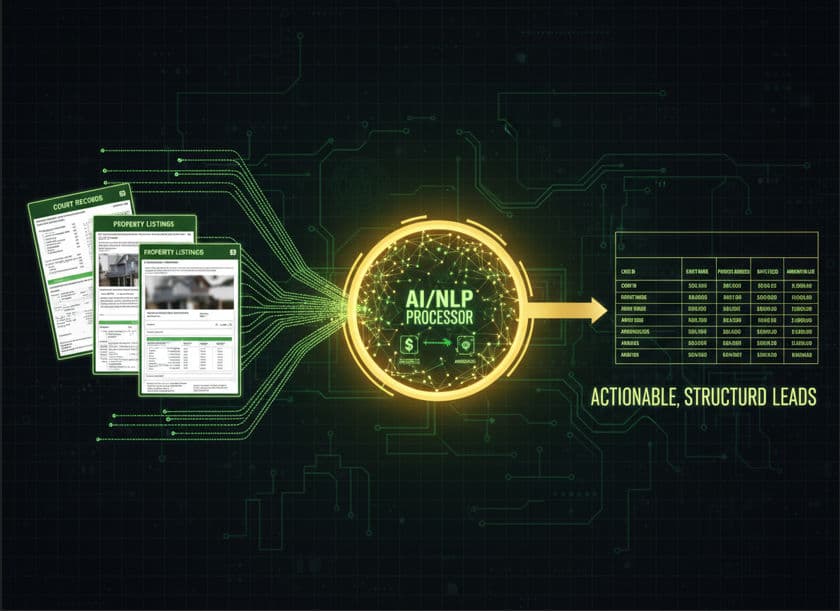
What our data shows
What the work has in common.
Most of our work sits under NDA. The 8 engagements we are free to write up carry 24 measured results between them, and read side by side rather than one at a time, they say four things fairly consistently — not all of them what we expected to find.
Most of the time we removed was waiting, not working.
The task itself was rarely the expensive part. The queue in front of it was — a form sitting unread, a call on hold, a list nobody had checked since yesterday morning.
Lead routing delayReal Estate
2.5 hours became Under 2 minutes
Intake processing cycleHealthcare & ABA
5+ business days became 4 hours
Response delayCrypto & Sales
Hours to days became Less than 2 seconds
Daily processing timeMortgage & Foreclosure
4–6 hours became ~5 minutes
Error rates collapsed rather than crept down.
Where a team measured its mistakes, the residual rate landed at or below one percent — from baselines of three to five percent, fifteen percent, and an estimated one in ten leads lost.
Data capture error rateMortgage & Loan Processing
3–5% became Below 1%
Data accuracyMortgage & Foreclosure
~85% became 99%
Lost leads per monthReal Estate
Estimated 10% became 0%
Roughly half the work was not worth automating.
The largest saving we have recorded came from an audit that recommended automating half a team's tasks and leaving the rest alone. Knowing which half is most of the job.
Manual workload reducedEnterprise Operations
50% of total tasks automated
Unnecessary AI spend avoidedEnterprise Operations
Significant — by not automating the unviable 50%
Human involvementMortgage & Loan Processing
100% manual became Less than 10%
Capacity rose without headcount rising with it.
In every case the ceiling had been the number of people available to sit through the work. Once that stopped being the constraint, volume moved and the team did not.
Processing capacityMortgage & Loan Processing
Limited by team size became 3× without new hires
Team members requiredMortgage & Foreclosure
3–5 people became 1 person
Daily outreach volumeCrypto & Sales
Limited by agent hours became 5× Increase
Every figure above is the one published on the case study it links to. Where a client asked not to be named, the engagement is described without them; where we cannot describe it at all, it is not here.
Read the engagementsWhere we work
Operations teams on four continents.
Regions
- United States
- United Kingdom
- Europe
- India
- United Arab Emirates
- Australia
Tell us the process nobody wants to own.
A 30-minute call. Bring the workflow that eats the most hours and we will tell you honestly whether it is worth automating — including when the answer is no.